
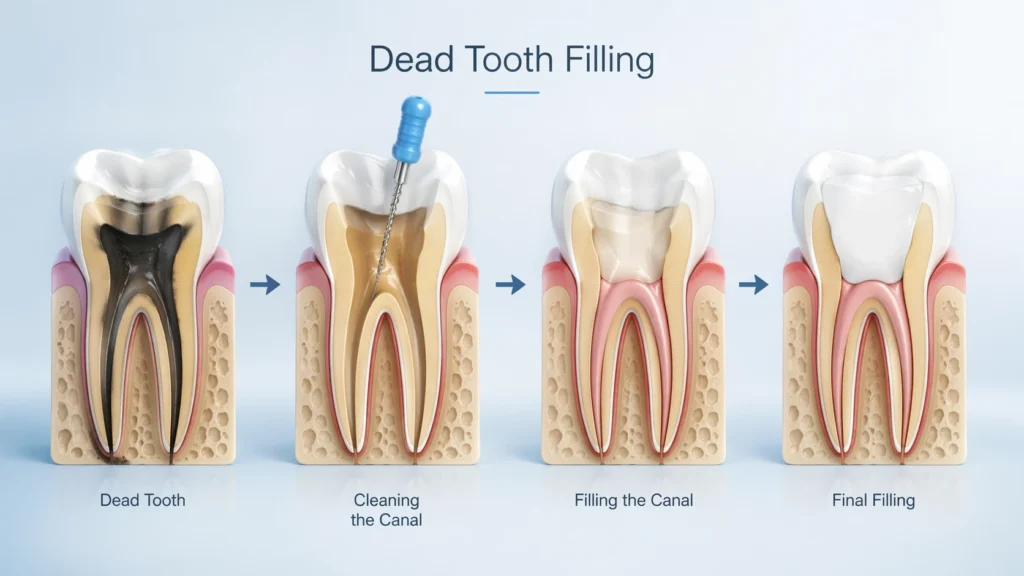
A dead tooth doesn’t always scream for attention. Sometimes, it sits quietly in your mouth—no pain, no warning—until the damage becomes serious. That’s where dead tooth filling comes in.
But here’s the real question:
Can you actually save a dead tooth with a filling, or is it already too late?
Let’s break it down in the simplest way possible so you know exactly what to do next.
What Is a Dead Tooth?
A tooth is called “dead” when the nerve inside it (the pulp) stops working. This usually happens because of:
- Deep decay
- Injury or trauma
- Infection inside the tooth
When the nerve dies, the tooth no longer feels pain. Sounds like a good thing, right?
Not really.
Because even though the pain is gone, the damage is still growing inside.
Can a Dead Tooth Be Filled?
Here’s the truth most people don’t hear:
👉 A dead tooth filling alone is usually NOT enough.
Why?
Because a filling only fixes the outer part of the tooth. But a dead tooth has problems deep inside.
So what’s the real solution?
In most cases, you’ll need:
- Root canal treatment (to clean the inside)
- Then a filling or crown (to restore the tooth)
That said, a dead tooth filling can be part of the process—but not the full treatment.

When Is a Dead Tooth Filling Used?
A dentist may use a dead tooth filling in these situations:
1. After a Root Canal
Once the infection is removed, the tooth becomes hollow and weak. A filling helps:
- Seal the tooth
- Prevent bacteria from entering again
- Restore basic function
2. Minor Damage (Rare Cases)
If the tooth is dead but not badly damaged, a filling may be used temporarily.
Signs You Might Need a Dead Tooth Filling
You might not feel pain, but your tooth will show signs.
Look for:
- Dark or gray color
- Bad smell or taste
- Swelling in gums
- Loose tooth feeling
- Small hole or visible decay
If you notice even one of these, don’t wait.
Dead Tooth Filling vs Root Canal: What’s the Difference?
Let’s make it super simple:
| Treatment | What It Does | When You Need It |
|---|---|---|
| Filling | Fixes outer tooth | Small decay |
| Root Canal | Cleans inside infection | Dead or infected tooth |
👉 A dead tooth filling without a root canal is like painting over rust. It may look okay, but the problem stays inside.
Step-by-Step: How Dead Tooth Filling Works
If your dentist decides a filling is needed after treatment, here’s what happens:
Step 1: Cleaning the Tooth
Any decay or damaged part is removed.
Step 2: Disinfection
The area is cleaned to remove bacteria.
Step 3: Filling Material
A special material (composite or amalgam) is placed.
Step 4: Shaping & Polishing
The tooth is shaped to match your bite.
Simple. Quick. Effective—but only if the inside is already treated.
Types of Fillings Used for Dead Teeth
Not all fillings are the same.
1. Composite Fillings (Tooth-Colored)
- Looks natural
- Best for front teeth
- Bonds well to structure
2. Amalgam Fillings (Silver)
- Strong and durable
- Used for back teeth
- Less aesthetic
3. Temporary Fillings
- Used after root canal
- Short-term solution
Your dentist will choose based on your tooth condition.
How Long Does a Dead Tooth Filling Last?
A good dead tooth filling can last:
- 5 to 10 years (sometimes longer)
But here’s the catch:
A dead tooth becomes brittle over time.
That’s why many dentists recommend a crown after filling for long-term protection.
Does Dead Tooth Filling Hurt?
Good news:
👉 No, it usually doesn’t hurt.
Why?
Because the nerve is already dead.
You may feel slight pressure, but no real pain.
What Happens If You Don’t Treat a Dead Tooth?
Ignoring it is the worst thing you can do.
Here’s what can happen:
- Infection spreads to gums
- Abscess forms (painful swelling)
- Bone damage around tooth
- Tooth breaks completely
- Tooth loss
In severe cases, the infection can even spread to other parts of your body.
Cost of Dead Tooth Filling
Costs vary depending on your location and treatment.
Approximate Range:
- Filling only: $50 – $300
- Root canal + filling: $300 – $1000+
- Crown (if needed): $500 – $1500
👉 In places like Pakistan, it’s usually much cheaper.
Is Tooth Extraction Better Than Filling?
Sometimes, yes.
If the tooth is:
- Severely damaged
- Cracked deeply
- Too weak to restore
Then removing it might be the better option.
But dentists always try to save the natural tooth first.
How to Take Care of a Filled Dead Tooth
Once you get a dead tooth filling, your job is simple:
Do This:
- Brush twice daily
- Use fluoride toothpaste
- Floss regularly
- Visit dentist every 6 months
Avoid:
- Biting hard objects
- Ignoring small cracks
- Skipping dental checkups
Because remember—a dead tooth won’t warn you with pain.
Common Myths About Dead Tooth Filling
Myth 1: “If it doesn’t hurt, it’s fine”
❌ Wrong. Dead teeth often don’t hurt at all.
Myth 2: “Filling alone can fix it”
❌ Not true. You usually need a root canal first.
Myth 3: “Dead tooth should always be removed”
❌ Not always. Many can be saved.
When Should You See a Dentist?
Don’t wait for pain.
Visit a dentist if:
- Your tooth changes color
- You feel pressure or swelling
- There’s a bad taste in your mouth
- You had an injury to your tooth
Early action = less cost + less damage.
Final Thoughts
A dead tooth filling is not a complete treatment—it’s just one step in saving your tooth.
The real fix usually starts with cleaning the inside (root canal), then protecting the tooth with a filling or crown.
So if you suspect a dead tooth, don’t ignore it.
Because the longer you wait, the fewer options you’ll have.
Quick Recap
- Dead tooth = no nerve, but still risky
- Filling alone is not enough in most cases
- Root canal + filling is the common solution
- Early treatment saves money and pain
- Ignoring it can lead to serious infection