Shadow boxing for beginners is one of the easiest ways to start boxing without expensive equipment, a gym membership, or a training partner. You only need a little space, a few minutes, and the willingness to move.
Many beginners think shadow boxing looks too simple to work. But once you understand how it trains your body and mind at the same time, everything changes. Professional fighters still use it every day for a reason.
If you want better fitness, faster hands, improved footwork, and more confidence, shadow boxing can help you build all of them together.
In this guide, you will learn exactly how to start shadow boxing the right way, common mistakes to avoid, beginner drills, and a simple routine you can follow today.
What Is Shadow Boxing?
Shadow boxing is a solo boxing workout where you throw punches, move your feet, and practice defense without hitting a real opponent.
You fight against an imaginary opponent while focusing on movement, balance, speed, and technique.
Think of it like practicing a dance before performing on stage. You repeat movements until they feel natural.
The best thing about shadow boxing for beginners is that it teaches the basics safely. You can improve your skills without getting punched or worrying about heavy equipment.
Why Shadow Boxing Is Perfect for Beginners
Many people jump straight into heavy bag training. Others start sparring too early. That usually leads to bad habits.
Shadow boxing slows everything down and helps you learn correctly.
Here are the biggest benefits.
Builds Proper Technique
Every punch starts with body position. Shadow boxing helps you learn how to move your shoulders, hips, feet, and hands together.
You begin to understand balance instead of just throwing wild punches.
Improves Cardio Fast
A few rounds of shadow boxing can leave beginners breathing hard.
It trains your heart, lungs, and muscles at the same time. Since you keep moving constantly, it burns calories quickly.
Develops Coordination
At first, your punches and footwork may feel awkward.
That is normal.
Shadow boxing trains your brain and body to work together smoothly.
Helps You Move Better
Boxing is not only about punches.
Movement matters just as much.
Shadow boxing teaches balance, rhythm, and quick footwork.
Builds Confidence
When you practice often, your movements become cleaner and faster.
That progress builds confidence naturally.
Basic Boxing Stance for Beginners
Before learning combinations, you need the right stance.
A good stance gives you balance, power, and protection.
If You Are Right-Handed
- Put your left foot in front
- Keep your right foot behind
- Bend your knees slightly
- Keep your hands up near your face
- Relax your shoulders
- Turn your body slightly sideways
If You Are Left-Handed
Do the opposite.
Place your right foot forward and left foot back.
The Main Punches You Need to Learn
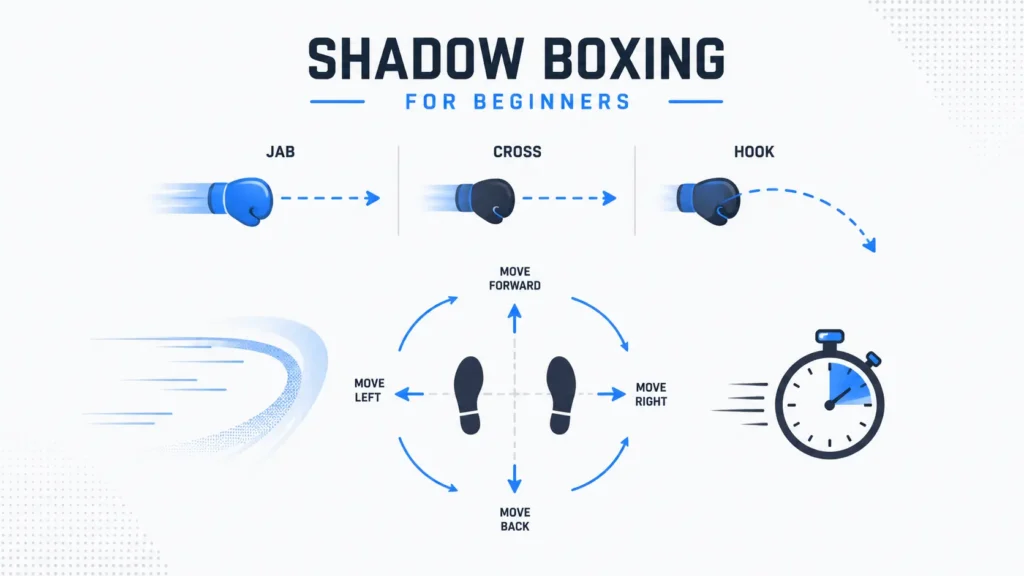
Shadow boxing for beginners becomes much easier when you focus on a few basic punches first.
Do not rush into flashy combinations.
Master the simple punches.
Jab
The jab is your front-hand punch.
It is fast, straight, and very important.
Use it to:
- Measure distance
- Set up combinations
- Keep opponents away
- Control rhythm
Cross
The cross is your back-hand straight punch.
This punch usually carries more power because your hips and shoulders rotate into it.
Hook
A hook moves in a curved path.
It targets the side of the head or body.
Beginners should focus on keeping hooks short and controlled.
Uppercut
The uppercut travels upward.
It works best at close range.
Do not swing wildly. Keep it compact.
How to Start Shadow Boxing the Right Way
Most beginners make one big mistake.
They throw punches too hard.
Shadow boxing is not about power.
It is about movement, technique, breathing, and rhythm.
Here is the right way to practice.
Step 1: Start Slow
Move slowly at first.
Focus on clean punches and balanced footwork.
Speed comes later.
Step 2: Keep Your Hands Up
Many beginners drop their hands after punching.
Always bring your hands back to guard position.
This builds defensive habits early.
Step 3: Move Your Feet
Do not stand still.
Take small steps.
Move forward, backward, left, and right while staying balanced.
Step 4: Breathe Properly
Exhale lightly with every punch.
Holding your breath will tire you quickly.
Step 5: Imagine a Real Opponent
Picture someone standing in front of you.
Imagine their punches and reactions.
This makes your shadow boxing feel realistic.
Common Shadow Boxing Mistakes Beginners Make
Everyone starts somewhere.
The goal is to avoid bad habits early.
Throwing Every Punch Hard
Shadow boxing is not heavy bag training.
You do not need maximum power.
Stay relaxed.
Standing Flat-Footed
Boxing requires movement.
Stay light on your feet.
Forgetting Defense
Do not only throw punches.
Practice slipping, blocking, rolling, and moving your head.
Looking at the Floor
Keep your eyes forward.
Imagine watching your opponent.
Rushing Combinations
Fast combinations mean nothing if your form breaks.
Clean technique matters more.
Best Beginner Shadow Boxing Combinations
You do not need complicated combinations in the beginning.
Simple combinations work best.
Combination 1
Jab → Cross
This basic combination teaches timing and balance.
Combination 2
Jab → Cross → Hook
This adds rotation and rhythm.
Combination 3
Jab → Jab → Cross
Double jabs help improve speed and control.
Combination 4
Cross → Hook → Cross
This teaches smooth transitions between punches.
Practice each combination slowly first.
Then gradually increase speed.
Simple Shadow Boxing Routine for Beginners
This beginner routine works well for home workouts.
Warm-Up – 3 Minutes
- Arm circles
- Jumping jacks
- Light jogging
- Shoulder rolls
Round 1 – Basic Movement
Focus only on:
- Footwork
- Guard position
- Breathing
- Light movement
Duration: 2 minutes
Round 2 – Jab Practice
Throw only jabs while moving.
Focus on speed and returning the hand quickly.
Duration: 2 minutes
Round 3 – Basic Combinations
Practice:
- Jab-cross
- Jab-cross-hook
- Double jab-cross
Duration: 2 minutes
Round 4 – Defense and Movement
Add:
- Slips
- Rolls
- Backward movement
- Side steps
Duration: 2 minutes
Cool Down – 3 Minutes
Stretch your:
- Shoulders
- Legs
- Neck
- Back
This routine takes less than 15 minutes.
Even short sessions help if you stay consistent.
How Often Should Beginners Practice Shadow Boxing?
Consistency matters more than long workouts.
For beginners, 3 to 5 sessions per week is enough.
You can start with:
- 10 minutes daily
- Or 20 minutes every other day
As your stamina improves, you can add more rounds.

Can Shadow Boxing Help With Weight Loss – Shadow boxing for beginners
Yes.
Shadow boxing burns calories while improving endurance.
Because your entire body moves together, it becomes an effective cardio workout.
Many people use shadow boxing for beginners as part of home fitness routines because it requires almost no equipment.
Combined with healthy eating, it can support weight loss goals.
Do You Need Equipment for Shadow Boxing?
No.
That is one reason shadow boxing is so popular.
You can practice almost anywhere.
Still, a few optional tools may help.
Mirror
A mirror helps you check your form.
You can spot mistakes quickly.
Hand Wraps
Hand wraps add wrist support during longer sessions.
Timer App
A boxing timer helps structure rounds and rest periods.
Shadow Boxing Tips That Make a Huge Difference
Small improvements create big results over time.
These tips will help beginners improve faster.
Stay Relaxed
Tension slows punches down.
Relax your shoulders and arms.
Focus on Form First
Good technique creates speed naturally.
Practice in Front of a Mirror
Watching yourself helps fix posture and balance.
Move After Punching
Never stay frozen after combinations.
Punch and move.
Keep Sessions Fun
Do not overthink everything.
Music, rhythm, and movement make training enjoyable.
Shadow Boxing vs Heavy Bag Training
Many beginners ask which one is better.
The truth is both help in different ways.
Shadow Boxing Helps With
- Technique
- Speed
- Movement
- Coordination
- Footwork
Heavy Bag Training Helps With
- Power
- Conditioning
- Punch impact
- Strength
Most fighters use both.
But shadow boxing for beginners is usually the smarter starting point.
Mental Benefits of Shadow Boxing
Most people focus only on physical fitness.
But shadow boxing also helps mentally.
It improves:
- Focus
- Discipline
- Stress relief
- Confidence
- Mental sharpness
Many people feel calmer after a few rounds.
The movement, breathing, and rhythm can clear your mind.
Beginner Goals You Should Focus On
Do not worry about looking perfect immediately.
Focus on small goals.
For example:
- Learn proper stance
- Improve balance
- Throw cleaner punches
- Build stamina
- Move smoothly
Small progress adds up quickly.
Final Thoughts – Shadow boxing for beginners
Shadow boxing for beginners is one of the easiest and smartest ways to start boxing.
You do not need expensive equipment.
You do not need a gym.
And you do not need experience.
All you need is consistency.
Start slowly.
Focus on clean movement.
Practice a few rounds every week.
Over time, your punches will feel sharper, your movement smoother, and your confidence stronger.
The best part is that shadow boxing works for almost everyone.
Whether your goal is fitness, weight loss, self-defense, or learning boxing basics, this simple workout can take you surprisingly far.
The first few sessions may feel awkward.
That is completely normal.
Keep practicing.
The improvement comes faster than most beginners expect.