
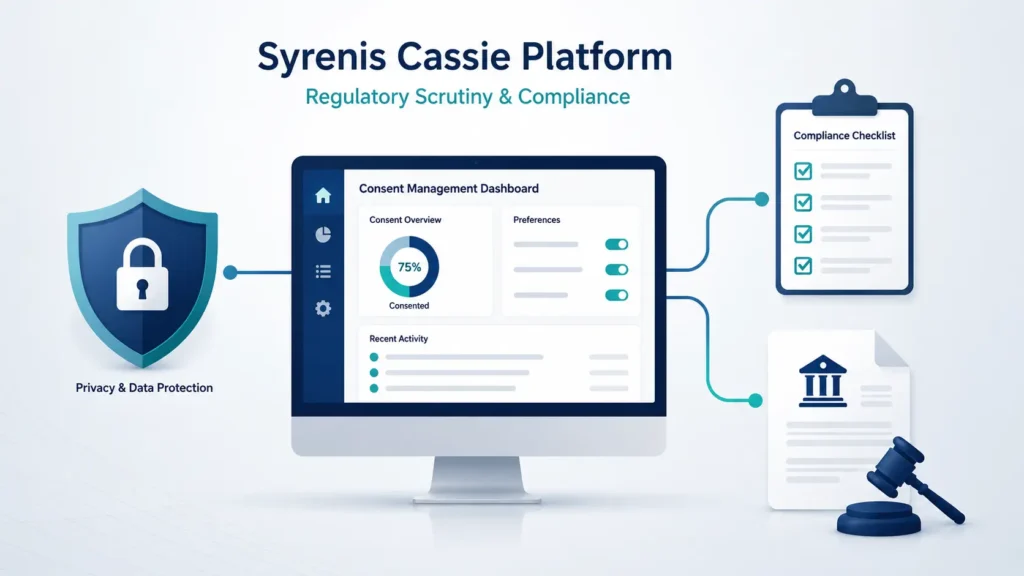
Privacy rules are changing faster than ever. Companies now have to prove that they collect, store, and use customer data in a legal and transparent way. That is why the syrenis cassie platform regulatory scrutiny topic has become increasingly important for privacy teams, compliance officers, and business leaders.
The Syrenis Cassie platform is designed to help organizations manage customer consent and communication preferences across multiple systems. While the platform itself is built to support compliance, businesses using any consent management solution should understand that regulators examine how organizations use these tools—not simply whether they have one installed.
This article explains what the Syrenis Cassie platform does, why regulatory scrutiny matters, how businesses can reduce compliance risks, and what to consider before implementing or expanding a consent management strategy.
What Is the Syrenis Cassie Platform?
Syrenis developed Cassie as an enterprise consent and preference management platform. Its purpose is to provide organizations with a central location for collecting, storing, updating, and enforcing customer consent choices across different systems and communication channels.
Instead of keeping consent records in separate marketing tools, CRMs, and websites, Cassie creates a single source of truth that can be shared across connected systems.
The platform supports organizations that operate under privacy regulations such as:
- GDPR
- CCPA and other U.S. state privacy laws
- HIPAA-related privacy workflows where applicable
- Other international data protection frameworks depending on business requirements
Why the Syrenis Cassie Platform Regulatory Scrutiny Matters
Regulatory attention focuses on organizations—not software
One common misunderstanding is that buying a compliance platform automatically makes a company compliant.
It doesn’t.
Regulators investigate whether an organization actually follows privacy laws. Software simply helps businesses manage the process more consistently.
During syrenis cassie platform regulatory scrutiny, the key questions usually include:
- Was customer consent collected properly?
- Can the company prove when consent was given?
- Were privacy choices honored?
- Were marketing messages stopped after consent was withdrawn?
- Is there an audit trail?
A platform like Cassie helps businesses answer these questions with centralized records and reporting, but companies must still configure and use the platform correctly.
How Cassie Supports Regulatory Compliance
Centralized consent management
One of Cassie’s strongest features is maintaining consent information in one location instead of scattered across multiple databases.
This reduces problems like:
- outdated preferences
- duplicate customer records
- inconsistent marketing permissions
- conflicting consent histories
A centralized approach also makes internal audits much easier.
Audit trails
Privacy laws increasingly require organizations to demonstrate compliance rather than simply claim it.
Cassie records consent events, preference updates, and policy changes to help organizations maintain an auditable history.
Preference management
Modern privacy goes beyond cookie banners.
Customers expect to choose:
- email communications
- SMS marketing
- newsletters
- promotional offers
- personalized experiences
Cassie allows organizations to manage these preferences from a unified platform.
Integration across business systems
Large organizations often use dozens of applications.
Cassie provides APIs and integration capabilities that synchronize consent data across CRM, marketing automation, websites, mobile apps, and customer service systems.
H2: Syrenis Cassie Platform Regulatory Scrutiny and Enterprise Risk
Large organizations face greater compliance challenges because they collect data through multiple channels.
For example, a retailer might collect consent through:
- website registrations
- mobile apps
- loyalty programs
- customer support
- in-store kiosks
If these systems don’t stay synchronized, customers may receive unwanted communications even after opting out.
That creates regulatory risk.
The syrenis cassie platform regulatory scrutiny discussion often centers on whether organizations can maintain accurate consent records across complex digital environments.
H3: Syrenis Cassie Platform Regulatory Scrutiny During Audits
Privacy regulators generally examine several areas during investigations.
Consent evidence
Organizations should be able to demonstrate:
- when consent was collected
- how it was collected
- which privacy notice was accepted
- whether consent has changed
Data governance
Auditors may also review:
- retention policies
- deletion procedures
- access controls
- internal governance
Preference enforcement
Collecting consent is only the beginning.
Companies must also prove they respected customer preferences after those choices were made.
Common Compliance Mistakes
Even organizations using sophisticated privacy software can experience problems.
Some common mistakes include:
Assuming technology solves compliance
Privacy software supports compliance.
It does not replace:
- legal review
- governance
- employee training
- documented processes
Poor integrations
If consent updates never reach marketing platforms, customers may continue receiving communications they rejected.
Outdated privacy notices
Consent should match the notice shown at the time it was collected.
Changing privacy terms without proper governance creates unnecessary risk.
Lack of regular testing
Businesses should periodically verify:
- cookie banners
- opt-out workflows
- API integrations
- preference centers
- deletion requests
Industries That Benefit Most
The Syrenis platform is commonly used by organizations operating in highly regulated environments where consent management is particularly important. These include:
- healthcare
- financial services
- retail
- media
- automotive
- education
- government organizations
These industries often process large amounts of personal information across multiple customer touchpoints.
Privacy Regulations Continue to Evolve
Another reason syrenis cassie platform regulatory scrutiny remains relevant is that privacy laws continue changing around the world.
Businesses now face growing requirements involving:
- transparency
- customer rights
- consent records
- cross-border data transfers
- data minimization
- preference management
Organizations need systems that can adapt without rebuilding their entire technology stack each time regulations change.
Syrenis positions its platform to support evolving privacy requirements across multiple jurisdictions.
Best Practices for Organizations Using Consent Platforms
Companies can improve compliance by following several practical steps.
- Keep consent records centralized.
- Review integrations regularly.
- Test customer preference workflows.
- Update privacy notices when regulations change.
- Maintain documented governance policies.
- Train employees handling customer data.
- Perform routine compliance audits.
- Monitor new privacy legislation.
These practices reduce operational risk regardless of which consent management platform an organization uses.
Is Regulatory Scrutiny a Bad Thing?
Not necessarily.
Regulatory scrutiny encourages organizations to improve privacy practices.
Businesses that maintain accurate records, respect customer choices, and document compliance are generally better prepared for audits than companies relying on manual spreadsheets or disconnected databases.
Modern consent management platforms help make that process more consistent, but success still depends on internal governance.
Conclusion
The growing focus on syrenis cassie platform regulatory scrutiny reflects a wider shift toward stronger privacy enforcement around the world. Regulators increasingly expect organizations to demonstrate—not simply promise—that they respect customer consent and manage personal data responsibly.
The Syrenis Cassie platform provides tools for centralized consent management, auditability, preference management, and enterprise integration that can support those goals. However, compliance ultimately depends on how organizations implement policies, train staff, maintain accurate records, and continuously review their privacy processes. Businesses that combine capable technology with strong governance are far better positioned to meet today’s regulatory expectations and adapt to tomorrow’s privacy requirements.
Frequently Asked Questions
What is the Syrenis Cassie platform?
Syrenis Cassie is an enterprise consent and preference management platform that helps organizations collect, store, synchronize, and enforce customer consent across websites, applications, CRM systems, and marketing platforms.
Why is the Syrenis Cassie platform under regulatory scrutiny?
The phrase syrenis cassie platform regulatory scrutiny generally refers to the increasing attention regulators place on how organizations manage customer consent and privacy. The focus is primarily on business compliance rather than on the software itself.
Does using Cassie guarantee GDPR compliance?
No. Cassie provides tools that support compliance, but organizations must still establish proper governance, legal processes, staff training, and ongoing compliance monitoring.
Which industries commonly use the platform?
Healthcare, financial services, media, retail, automotive, education, and government organizations commonly use enterprise consent management platforms because they process large volumes of personal data.
What are the biggest compliance risks for businesses?
The most common risks include poor consent records, disconnected systems, outdated privacy notices, failure to honor customer preferences, and weak internal governance.
How can businesses prepare for regulatory audits?
Organizations should maintain centralized consent records, perform regular compliance reviews, document privacy processes, test integrations, and ensure customer preferences are consistently respected across all systems.