
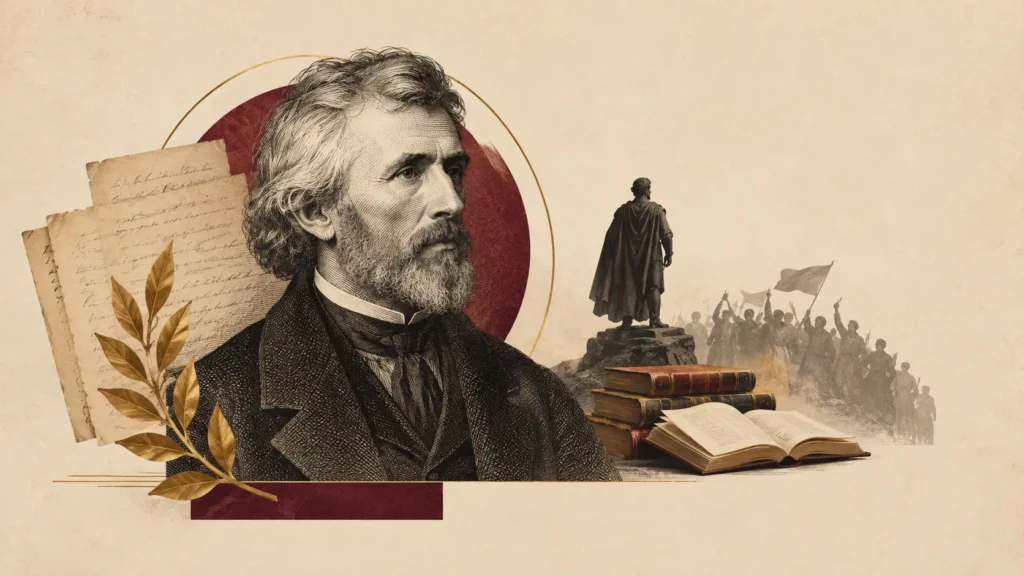
History is often remembered through the names of a few extraordinary people. We associate the American Civil Rights Movement with Martin Luther King Jr., the Indian independence movement with Mahatma Gandhi, and major military campaigns with the commanders who led them. But how much of history is really the work of individual leaders, and how much depends on the people and circumstances surrounding them?
This question lies at the heart of the Thomas Carlyle Great Man Theory, a historical perspective that gives exceptional individuals a central role in shaping human events. Developed during the nineteenth century, the theory suggests that influential leaders, thinkers, reformers, and visionaries can change the direction of entire societies through their abilities, ideas, and actions.
Scottish writer and historian Thomas Carlyle presented his influential views on heroes in a series of lectures in 1840, later published as On Heroes, Hero-Worship, and the Heroic in History. His ideas became closely associated with the Great Man Theory of history.
Although the theory remains influential in discussions about leadership and historical change, it has also attracted serious criticism. Understanding both its strengths and weaknesses offers a clearer picture of how individuals influence the world.
Who Was Thomas Carlyle?
Thomas Carlyle
Thomas Carlyle was a Scottish essayist, historian, and social critic who lived from 1795 to 1881. He became known for his distinctive writing style, strong opinions about society, and interest in the individuals who influenced historical events.
His major works include The French Revolution: A History and On Heroes, Hero-Worship, and the Heroic in History. Through his writing, Carlyle explored political upheaval, moral responsibility, leadership, and the relationship between individuals and their societies.
Carlyle believed that history could not be fully understood by examining institutions, economic conditions, or social movements alone. He argued that the character and insight of remarkable individuals also deserved serious attention.
His lectures on heroism examined different kinds of influential figures, including religious prophets, poets, writers, reformers, and political rulers. Rather than limiting greatness to military victories or political power, Carlyle considered several ways individuals could shape how people thought and lived.
This broad understanding of heroism is essential to interpreting his theory accurately.
What Is the Thomas Carlyle Great Man Theory?
The Thomas Carlyle Great Man Theory is the view that exceptional individuals play a major role in shaping history. According to this approach, certain people possess unusual abilities, insight, determination, or leadership qualities that allow them to influence events far beyond their immediate surroundings.
Carlyle expressed this perspective directly in his 1840 lectures, arguing that the history of humanity could be understood largely through the lives and achievements of great individuals.
The central idea is straightforward: major historical changes often become possible because particular individuals recognize opportunities, develop powerful ideas, make consequential decisions, or inspire others to act.
Consider a political revolution. Economic hardship and public anger may create the conditions for change, but a persuasive leader can help turn widespread frustration into a coordinated movement. Similarly, scientific progress may depend on existing knowledge, yet an individual researcher can make a discovery that changes an entire field.
The theory emphasizes that individual ability matters. It does not, however, provide a complete explanation of every historical event, and it should not be confused with the claim that every successful leader works entirely alone.
The meaning of a “great man”
In Carlyle’s historical framework, a great man was more than someone who possessed wealth, fame, or political authority. He valued people whom he believed had unusual insight into their time and the ability to express ideas that others could recognize as important.
Carlyle also emphasized sincerity and conviction. In his view, genuine heroes were deeply committed to what they believed to be true and could influence others through their character and actions.
His examples covered several categories:
- Religious figures: People who shaped spiritual beliefs and religious traditions.
- Writers and poets: Individuals whose works influenced culture and public thought.
- Reformers and teachers: Figures who challenged existing ideas and encouraged new ways of thinking.
- Political and military leaders: Individuals whose decisions influenced governments, conflicts, and national histories.
These categories demonstrate that Carlyle’s idea of greatness was connected to cultural and intellectual influence as well as political power.
The Main Principles of Carlyle’s Theory
The Great Man Theory is easier to understand when its central principles are examined separately.
1. Exceptional individuals can change history
Carlyle placed considerable importance on individuals who possess unusual qualities. He believed their ideas, decisions, and personal abilities could influence the direction of society.
A leader who challenges an established system, for example, may introduce ideas that eventually reshape laws, institutions, or public attitudes.
From this perspective, historical progress is not simply the result of impersonal forces. Individual decisions can influence when change happens, what form it takes, and how far it reaches.
2. Leadership depends on more than position
Holding political office or commanding an army does not automatically make someone a great leader. Carlyle’s emphasis on insight and conviction suggests that influence depends partly on a person’s ability to understand circumstances and communicate ideas.
A person without formal authority may influence society through writing, teaching, religious leadership, or public advocacy.
This helps explain why Carlyle included poets, writers, and religious figures alongside kings and commanders in his discussions of heroism.
3. Great leaders inspire other people
Individual achievement alone cannot explain every major historical development. Leaders often influence events because other people respond to their ideas, trust their judgment, or choose to support their goals.
A reformer may articulate a vision, but a movement needs supporters to spread the message and turn it into action.
Carlyle nevertheless gave greater prominence to the exceptional individual than many later approaches to history would consider justified.
4. Historical figures must be understood in context
Although the Great Man Theory is commonly summarized as the idea that individuals make history, Carlyle’s discussions also considered how different types of heroes emerged in different historical periods.
His lectures examined figures who responded to the beliefs and needs of their societies. This creates an important distinction: a leader’s influence may be exceptional, but the historical circumstances surrounding that person still matter.
The theory is most useful when it encourages serious study of individual character and decisions rather than treating historical figures as isolated from the world around them.
Famous Examples of the Great Man Theory
Carlyle used historical figures to illustrate different forms of heroism. His examples help explain how the theory connects personal influence with wider historical developments.
1. Martin Luther — Religious reform
Martin Luther challenged established religious practices in sixteenth-century Europe. His writings and criticism helped fuel the Protestant Reformation, although political conflicts, printing technology, and wider religious tensions also contributed to its spread. Carlyle discussed Luther as an example of the hero as priest.
2. Oliver Cromwell — Political leadership
Cromwell played a major role in the English Civil Wars and the political changes that led to the establishment of the Commonwealth. His career illustrates how the decisions and ambitions of powerful leaders can reshape political institutions. However, his influence depended on military forces, parliamentary conflicts, and the wider political circumstances of seventeenth-century England.
3. William Shakespeare — Literary influence
Shakespeare transformed English drama through plays and poetry that continue to be studied and performed. Carlyle included him among his examples of heroic poets. His influence shows that historical importance does not always require political office or military power; creative work can shape language, culture, and public imagination over centuries.
4. Napoleon Bonaparte — Military and political power
Napoleon rose to prominence during the French Revolution and became emperor of France. His military campaigns and government reforms had lasting consequences across Europe. Carlyle treated him as an example of the hero as king, but Napoleon’s career also reveals a weakness in equating influence with virtue: a powerful individual can change history through actions that cause enormous suffering as well as institutional change.
These examples demonstrate the breadth of Carlyle’s approach. Yet they also raise an important question: does historical importance necessarily make someone admirable? Influence, moral character, and the consequences of leadership are separate issues.
Criticism of the Thomas Carlyle Great Man Theory
Despite its influence, the Great Man Theory is widely criticized for offering an incomplete explanation of historical change. Modern historical analysis often combines individual biographies with economic, political, cultural, and social evidence.
It overlooks the role of ordinary people
One major criticism is that the theory can make history appear to be the achievement of a few exceptional individuals.
In reality, political movements, scientific discoveries, and social reforms often depend on thousands or millions of people. Workers, organizers, soldiers, teachers, families, and local communities may contribute to developments that later become associated with a famous leader.
For example, a civil rights leader may provide direction and public visibility, but lasting reform usually requires community organizing, legal work, public participation, and institutional change.
A biography focused entirely on the leader can overlook the people whose efforts made progress possible.
It underestimates social and economic conditions
Leaders do not act in isolation. Their decisions are shaped by the opportunities and restrictions of their time.
Economic crises, technological developments, social inequality, international conflicts, and political institutions can all influence the course of events.
A leader may accelerate a revolution, but the conditions that make a revolution possible often develop over many years. Without those conditions, the same individual might have achieved very different results.
Historical explanation therefore needs to examine both personal agency and the environment in which people act.
It can encourage hero worship
Carlyle’s admiration for exceptional individuals creates another difficulty: readers may confuse fame or power with wisdom and moral goodness.
When a leader is treated as a heroic figure, mistakes, abuses of power, and harmful consequences can receive less attention than achievements.
A balanced assessment must examine evidence rather than assume that an influential person deserves admiration. It should consider who benefited from the person’s actions, who suffered, and how later events changed the interpretation of their legacy.
It is difficult to test the theory
Another problem is determining whether a particular individual was truly responsible for a historical outcome.
Imagine a scientist making a major discovery. Was the result primarily due to personal genius, earlier research, access to equipment, collaboration with colleagues, or favorable circumstances?
Often, several factors contributed.
Researchers can study individual decisions and their consequences, but it is much harder to prove that history would have unfolded in the same way without a particular person. This makes sweeping claims about great individuals difficult to establish conclusively.
Leo Tolstoy’s critique of leader-centered historical narratives, discussed in a scholarly article published in Leadership, highlights how accounts of history can exaggerate the power of prominent figures while overlooking the wider forces shaping events.
Great Man Theory vs. Modern Views of History
The difference between Carlyle’s approach and broader historical explanations is not simply that one values leaders while the other ignores them. The key distinction is how much explanatory weight each approach gives to individuals compared with other forces.
| Approach | Main focus | Key limitation |
|---|---|---|
| Great Man Theory | Exceptional individuals and their decisions | Can overlook collective action and structural conditions |
| Social history | Ordinary people, communities, and social relationships | May understate the influence of particular leaders |
| Economic history | Resources, labor, markets, and material conditions | May give insufficient attention to personal beliefs and choices |
| Institutional analysis | Laws, governments, organizations, and systems | Can overlook the role of individual judgment and initiative |
These approaches can complement one another. A detailed study of a revolution, for example, might examine a leader’s decisions, public participation, economic pressures, and the institutions that either enabled or resisted change.
This combination produces a richer explanation than relying on a single theory.
Is the Great Man Theory Relevant Today?
The Great Man Theory remains useful as a starting point for discussing leadership, responsibility, and individual influence. It reminds readers that decisions made by particular people can have consequences that extend far beyond their immediate circumstances.
In business, a founder may establish a company’s vision and culture. In science, a researcher may introduce an idea that changes a field. In politics, a leader may influence public opinion or decide how a government responds to a crisis.
However, these achievements rarely happen without support. Businesses rely on employees and customers, scientific advances depend on research communities, and political leaders operate within institutions and social movements.
The modern lesson is not that exceptional individuals are unimportant. It is that their influence must be understood alongside the people, systems, and circumstances that make their achievements possible.
The theory can also encourage useful questions about leadership. What qualities help a person recognize an opportunity? How do ideas gain public support? Why do some leaders build lasting institutions while others leave little positive legacy?
These questions preserve Carlyle’s interest in individual character without accepting every assumption of his approach.
Why Thomas Carlyle’s Theory Still Matters
The lasting significance of Carlyle’s ideas lies in the debate they created about the relationship between individuals and history. His work encouraged readers to take biography, character, and leadership seriously. Later critics challenged the tendency to make famous individuals the center of every historical explanation.
Both perspectives offer something valuable. Institutions and social movements do not make decisions by themselves; individuals influence them. At the same time, individuals need resources, opportunities, supporters, and circumstances in which their choices can have an effect.
A leader may change the direction of a movement, but the movement’s success can depend on countless contributions that never receive the same historical attention.
Conclusion
The Thomas Carlyle Great Man Theory argues that exceptional individuals play a decisive role in shaping history through their insight, character, leadership, and achievements. Carlyle’s examples of religious figures, writers, and political rulers show that he understood heroism as more than military success or formal authority.
Nevertheless, the theory has important limitations. It can overlook ordinary people, underestimate social and economic forces, and encourage excessive admiration for powerful figures.
The most balanced approach is to recognize individual influence without treating it as the sole cause of historical change. By examining leaders alongside their societies, institutions, and supporters, we can understand not only who shaped history, but also how and why their actions mattered.
For readers exploring leadership or historical interpretation, Carlyle’s theory remains a useful starting point—not a complete explanation of the past, but an invitation to ask better questions about the people who change the world.
8. Frequently Asked Questions
1. What is Thomas Carlyle’s Great Man Theory?
Thomas Carlyle’s Great Man Theory argues that exceptional individuals, including leaders, thinkers, writers, and reformers, play a major role in shaping history through their abilities, ideas, and decisions.
2. When did Thomas Carlyle introduce the Great Man Theory?
Carlyle presented his ideas about heroes in a series of lectures in May 1840. These lectures were later published as On Heroes, Hero-Worship, and the Heroic in History.
3. Who are examples of great men in Carlyle’s theory?
Carlyle discussed figures such as Martin Luther, William Shakespeare, Oliver Cromwell, and Napoleon Bonaparte. He selected individuals from religion, literature, and politics to illustrate different forms of historical influence.
4. What are the main criticisms of the Great Man Theory?
Critics argue that it gives too much attention to prominent individuals while overlooking ordinary people, collective action, economic conditions, social movements, and institutions that also shape historical events.
5. Is the Great Man Theory still relevant today?
Yes. It remains useful for discussing leadership and individual responsibility. However, modern historical analysis generally benefits from examining individual influence alongside social, political, economic, and cultural factors.